From the first CSV import to the evidence in front of an assessor — every stage, what happens inside it, and what the system refuses to let happen at all.
One job per delivery, and the condition recorded while the customer is still at the counter.
Photographs and notes on arrival — the thing that settles “it was already like that”, which is an argument no laboratory wins from a text field written afterwards.
Every instrument on the delivery becomes a job item with its own state, so a job of eleven jacks reports eleven progressions rather than one word.
Labels and test tags print immediately, as ZPL, straight to the printer.
A returning instrument is found by scanning the sticker already on it rather than typed at a counter with somebody waiting.
02
Bench and batch
One instrument in depth, or a pallet of them in a grid. The trolley decides which.
The bench sheet carries the readings, the standards cited, the condition, the computed result and the grade — with the sentence saying what limited it.
The batch grid is built for volume: hundreds of appliances or leads in a day, most of them passing, entered across rather than down.
Check plans are saved once per instrument type and loaded into either, so the checks are never retyped per job.
Readings are validated as they are typed, and the drift check reads the instrument’s own history — the check most likely to catch a transposed digit that sits inside range.
On site with no signal, readings are captured on the device and sync when it reconnects. The engine does not run offline, and that is deliberate.
03
The calculation engine
Pure, deterministic, and the part an assessor will actually scrutinise.
Three families cover the work: force and jacks to AS 2193, load cells with interleaved zeros, and a tolerance band for everything else — including go/no-go checks with no numeric reading and one-sided limits where a standard bounds a quantity one way.
Decimal arithmetic throughout, for money and metrology alike. Never a float.
A full uncertainty budget: contributions, combined standard uncertainty, effective degrees of freedom by Welch–Satterthwaite, coverage factor, expanded uncertainty.
Raw inputs, template version and engine version are all stored, so the same certificate recomputes to the same value years later.
The decision rule under §7.8.6 — simple acceptance or guard banding — is declared by the laboratory. The system requires one and will not choose it.
04
Certificate or inspection report
Decided by the item, never by the shape of the check.
At issue the engine recomputes every value from the stored inputs and refuses if one of them differs. What the document says is what the engine produces.
The PDF is immutable, its SHA-256 recorded, and the original kept forever. An amendment is a new linked version; nothing is overwritten.
An inspection report carries no grade and never an accreditation mark, because inspection accreditation is ISO/IEC 17020 — a separate scheme with its own assessment.
A repair report is a document in its own right, because a repair voids the calibration and that has to be said somewhere.
05
Invoice
Drafted from the work that was done, not typed from scratch afterwards.
The certificated items on a job become the invoice lines, priced from your own book, with the certificate numbers attached.
GST handled correctly for a registered laboratory and for a sole trader below the threshold, who must not issue a tax invoice at all.
Invoicing is refused until the laboratory has answered its own tax position, because both possible defaults are harmful and one costs a ninth of every invoice.
06
Payment
Card, PayID or bank transfer — and the reconciliation that follows.
Stripe for cards and subscriptions.
Paste a bank statement and each deposit is matched against the open invoices. Suggestions only: a payment is recorded on its own invoice, by a person.
Overdue invoices climb a reminder ladder that stops the moment payment lands. A failed card restricts nothing for thirty days.
07
Recall
The part that protects the revenue, and the part a spreadsheet cannot do.
A seven-rung ladder: 90, 60, 30 and 7 days before due, on the due date, then 14 and 30 days after. One message per customer per rung.
It stops the moment they book, and stops altogether after a month — an instrument nobody has brought in by then needs a person, not another email.
Companies with no working address are counted and listed, because a customer you cannot reach is a customer you cannot recall.
Bounces are fed back to the record, so a dead address stops being silently retried.
Getting started
Twelve things, counted rather than ticked
Three short questions to sign up, then the records come in and the system tells you where you stand — computed from what it can actually see, not from a checklist somebody works through.
Signing up
What kind of work you do, how big the laboratory is, then the account details. The size answer selects the plan. Email verification is required before the account activates, and the link doubles as the first sign-in.
Bringing the records in
CSV import for customers, contacts, instruments and reference standards — in that order, because each depends on the one before it. Every run names the rows it cannot read with the reason, and writes nothing until you have seen what the run would do. Legacy identifiers are preserved in an indexed array, so the numbers your customers already quote stay searchable forever.
Saying what the laboratory does
Choose fields. The instrument catalogue, the saved check plans and the standards cited all narrow to them, and twelve check plans across seven fields arrive ready-made — the checks for an instrument type, saved once instead of typed per job.
What readiness actually reports
Item
What it gates
The laboratory’s identity for the letterhead
Certificates
At least one usable reference standard
Certificates
An approved procedure
Certificates
An authorised signatory with current competence
Certificates
External certificates for the masters
Accreditation
The declared decision rule (§7.8.6)
Accreditation
ABN
Invoicing
GST registration answered
Invoicing
Bank details
Invoicing
A price book
Invoicing
Customers reachable by email
Recall working at all
No critical data-quality issues
Work
The system refuses to invent any of them. A master’s calibration date, who is competent to sign, whether you are registered for GST — each is refused until answered, because a plausible default is the expensive kind of wrong. One of the two possible GST defaults quietly costs a registered laboratory a ninth of every invoice.
7 roles · 28 permissions
People, and what each of them may do
Roles are permissions rather than job titles, and the refusal is in the database rather than in the interface — a permission that only hides a button is not a permission.
Role
Permissions
What it is for
Administrator
28
Full access. Cannot alter an issued certificate or the audit log — nobody can.
Lab Manager / Technical Signatory
22
Runs the technical side: issues certificates, approves methods, manages standards and competence.
Technician
10
Does the calibration work. Deliberately cannot see pricing, invoices or customer financials.
Front Desk / Receiving
10
Books instruments in and out, prints labels and receipts, handles collections. Cannot change results.
Finance
10
Quotes, invoices, payments and the rate card. Cannot alter any technical result.
Auditor (read-only)
10
The login handed to a NATA assessor. Sees everything, changes nothing.
Customer
4
A customer, seeing only their own company’s instruments, certificates and invoices.
Signing in
Magic link for portal users — no password to lose.
Two-factor for staff: optional to enrol, mandatory once enrolled. The moment somebody has a factor, a restrictive policy on every table refuses a password-only session, and no setting anywhere can reach that. Whether to require enrolment is your own risk decision about your own records, and it is off by default.
The operator console is always mandatory — one session there reads every laboratory, which is not any one laboratory’s call.
Joining, leaving and competence
Invitations by email, scoped to a role.
Somebody who leaves is suspended, not deleted: their seat is freed and everything they signed stays exactly where it is.
Competence records say who may perform each method and who may sign for it, and a certificate cannot be issued by somebody without a current record for that method. It is the first thing an assessor tests.
§6.2.5(e) forbids self-assessment, so a laboratory of one names an external assessor with their organisation — which is how a sole practitioner becomes accreditable without hiring anybody.
More than one address
Multi-site
Locations are first-class: work, people and instruments belong to one.
A person’s role travels with them, so a technician covering another site for a week needs no new account and no temporary permissions.
Certificates carry the location that did the work, because that is what an assessor asks about a scope held at more than one address.
The first location is included on every plan and additional ones are charged, but they are counted, never enforced — nothing refuses to take work in because a counter rolled over.
Recall, digest and dunning all run across every site at once, so nothing is missed because a branch was between managers.
11 documents
What comes out
Every one deterministic and byte-reproducible — no headless browser anywhere in the path, so the same inputs produce the same bytes and a hash means something.
Document
What it is
Calibration certificate
Results, uncertainty, grade, standards cited, method and version, signatory, and a QR verification token.
Inspection report
Criteria, readings, outcome. No grade, and never an accreditation mark.
Repair report
A first-class document. A repair voids the calibration, and nobody else in this market models that.
Quote
Priced from your own book, sent as a link, accepted with no login.
Tax invoice
Correct for a registered laboratory and for a sole trader below the threshold.
Receipt
Including the condition noted on arrival, on the customer’s copy.
Calibration label
ZPL, straight to a Zebra or Brother printer. No driver, no print dialogue.
Test tag
For an inspected item, reading next test due — because the person holding it cannot see which document stands behind it.
Assessment pack
Your own records, clause by clause, in one document.
Management review pack
Generated from the records for a stated period; every number recomputable.
Record export
64 tables in 8 groups, as CSV with a manifest. At any time, whatever the state of any subscription.
Immutability
An issued certificate cannot be altered by anybody, including an administrator. An amendment is a new linked version and the original is retained forever. The PDF sits in a private, immutable bucket with its SHA-256 recorded, and both of its internal dates are pinned to the issue date — without that the hash would change with the second it was rendered in.
Branding
Your logo, your colour and your own footer on every document, included on every plan and never an upsell. A laboratory whose documents look like somebody else’s software is a laboratory that will not put them in front of a customer.
Public verification
Something your customer can check without ringing you
Every certificate carries a QR code. The person holding the instrument — a site supervisor, a safety officer, somebody in procurement — scans it and sees whether the calibration is current. No login, no account, no app.
The token is random, never sequential. A sequential id would let anybody enumerate every certificate you have ever issued.
It also works by typing the certificate number.
A document that has been amended or withdrawn says so, plainly.
Verification never stops, even if the subscription does — the person scanning it is not our customer and never agreed to anything with us.
An inspected item gets a test tag rather than a calibration sticker, reading next test due, because the person holding it cannot see which document stands behind it and should not have to know the difference.
Nobody else in this market offers verification at all. It is the feature a laboratory gets asked about by its own customers.
ISO/IEC 17025 · 13 registers
The quality system, as a by-product of the work
Filled in by doing the job rather than the week before an assessment — and every one of them is on the smallest plan, because a laboratory that cannot record a complaint because of its subscription stops recording complaints.
Register
Clause
What it does
Nonconforming work
§7.9
When a master is found wanting, this works out what it touched.
Complaints
§7.10
The outcome must be decided by somebody not involved in the work complained about — enforced, not trusted.
Corrective actions
§8.7
What changed so it does not happen again. The register most laboratories cannot evidence.
Document control
§8.3
One version in force at a time, approved by somebody other than its author.
Competence
§6.2
Who may perform each method, and who may sign for it.
Validity of results
§7.7
Intermediate checks plotted against each master’s own history.
Risks
§8.5
What could go wrong, how bad, what is being done, whose name, and a date to look again.
Internal audits
§8.8
A programme rather than a stack of reports: what has not been looked at this cycle.
Management review
§8.9
A pack built from the records for a stated period.
External providers
§6.6
Subcontractors, whoever calibrates your masters, critical supplies.
Customer feedback
§8.6.2
Sought, positive and negative, analysed and used.
Interlaboratory comparison
§7.7.2
Proficiency testing and comparison against other laboratories.
Accreditation scope
—
Quantity, range, method and best capability, as an accreditation body granted it.
And the evidence an assessor actually asks for
The assessment pack — your own records, clause by clause, in one document. Each row names the screen it came from, so “show me” has somewhere to go.
The audit trail — written by database trigger rather than by application code, so a change made outside this application is recorded too. No role, administrator included, can edit or delete an entry.
A read-only login built for an assessor — sees everything, changes nothing. Handing an assessor a manager’s login is how a laboratory ends up explaining a change made during an assessment.
Export — every record you hold, as CSV with a manifest, at any time, whatever the state of any subscription. Leaving is a download rather than a negotiation.
The screens
What it looks like
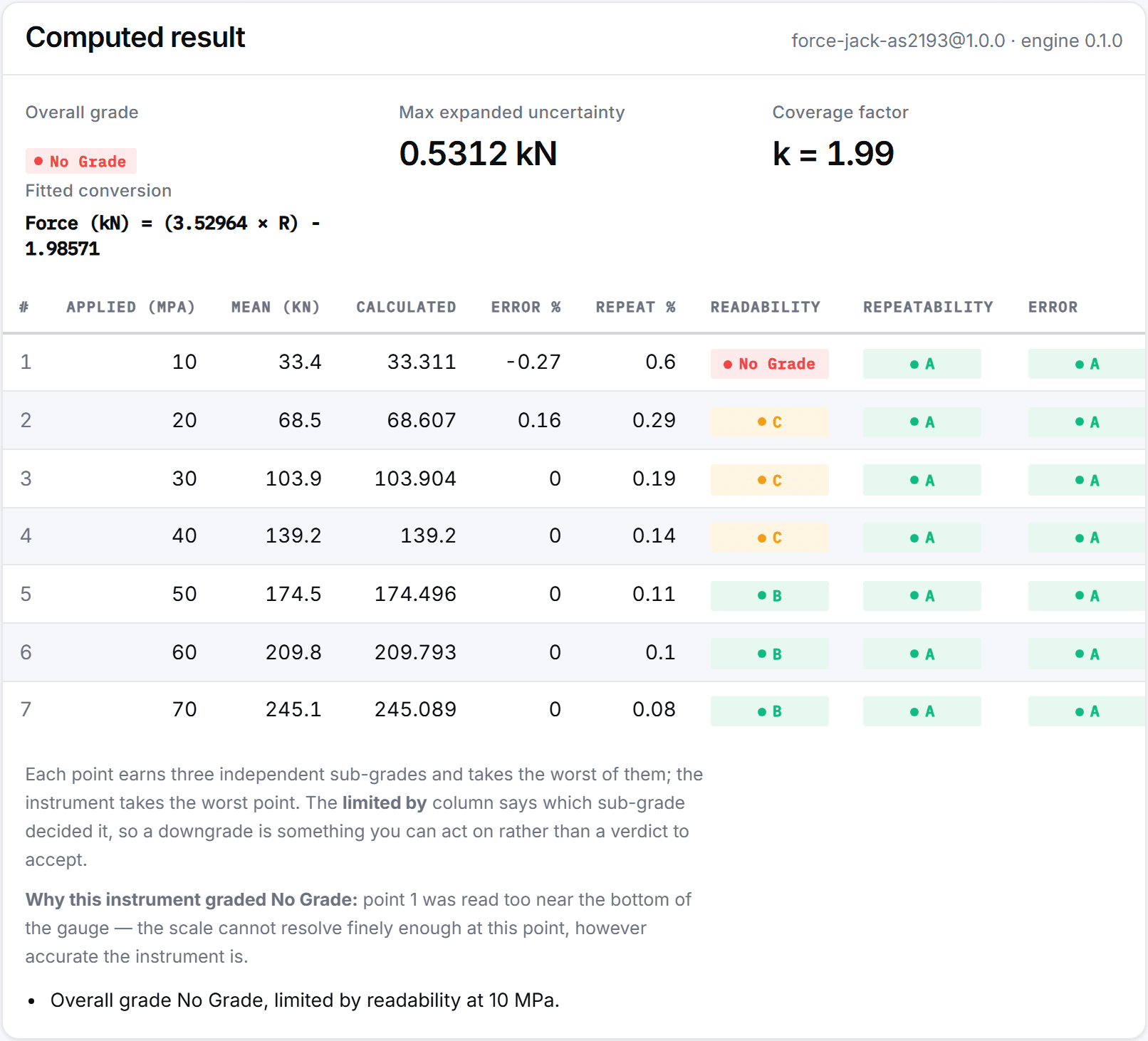
Readings in, grade and uncertainty computed, engine version recorded — and the sentence saying which point limited the grade.
For your customers
The customer portal
Your customers get their own login, and it costs you nothing — portal logins are never charged for, and there may be hundreds of them.
Their own instruments, with what is out of calibration and what falls due within thirty days
Their certificates and inspection reports, downloadable, with amendments visible
Quotes to accept or decline, with no login required to accept
Invoices, and what is outstanding
They see nothing of any other company, and the database enforces that rather than the interface. A portal user is not a seat, and suspending one frees nothing because it never occupied anything.
A customer who can see their own due dates is a customer who rings you before you have to ring them.
Integrations
Getting data in and out
Channel
What it carries
REST API
Instruments, jobs, certificates and invoices, with a published OpenAPI document.
API keys
Issued per laboratory, scoped, revocable.
CSV import
Customers, contacts, instruments, reference standards. Dry run first, always.
CSV export
Every table you hold, with a manifest, at any time.
ZPL printing
Direct to Zebra and Brother label printers.
SMTP
Any provider. Full send log with the provider’s own message ids.
Stripe
Cards and subscriptions, in Australian dollars.
Bank statements
Pasted and reconciled against open invoices.
Webhooks
Email delivery events and payment events.
Offline sync
Device-captured readings, uploaded on reconnect.
Security and tenancy
Where your data is, and who can see it
Multi-tenant from the first commit, and proved against a second live laboratory rather than asserted. Row-level security is forced on every tenant table, not merely enabled.
Data at rest in Sydney. The privacy policy is derived from the sub-processor register rather than written by hand, so it cannot claim residency the deployment does not have.
A published sub-processor register naming every party and what each one can see.
Private storage, signed URLs, and certificates in an immutable bucket with their hashes recorded. Attachments are served through the application to signed-in staff, never from a public link, and checked against their recorded hash on the way out.
An operator must never read a laboratory’s customers. Platform-side surfaces over the email log and audit log are aggregates only, and a database policy aborts the deployment if a later version ever starts returning a recipient address or a before-and-after value.
Runbooks for breach notification, backup and restore, and tenant onboarding.
Put your real work in it
The trial has everything in it and takes no card. The system refuses to invent a reference standard, a competent signatory or an approved procedure for you — so the trial is the time to put the real ones in.